

IoT In Logistics Market Register Growth of 13.2% CAGR To Reach USD 130.5 billion by 2035: Market Research Future
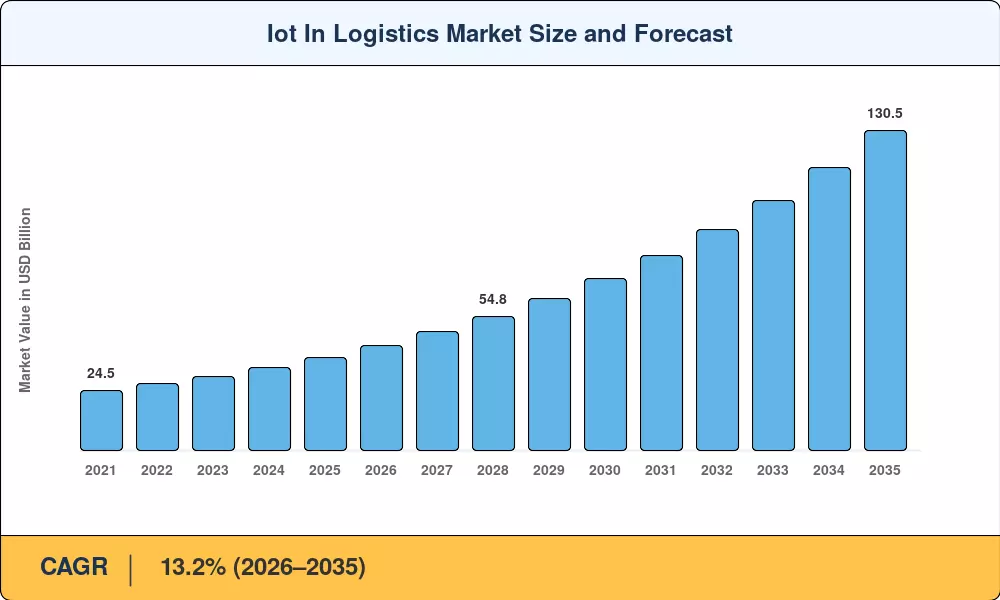
Iot In Logistics Market Size Outlook
Healthcare and pharmaceutical logistics are expanding at a CAGR of 14.6%, fueled by serialization mandates and vaccine distribution chain requirements.
NY, CA, UNITED STATES, June 22, 2026 /EINPresswire.com/ -- The global IoT In Logistics Market stood at an estimated USD 37.8 billion in 2025 and is projected to reach USD 130.5 billion by 2035, expanding at a compound annual growth rate of 13.2% during the 2026–2035 forecast window.IoT In Logistics Market Overview
The Internet of Things (IoT) in logistics market encompasses the integration of connected devices, sensors, and data analytics platforms to optimize supply chain operations, enhance real-time visibility, and improve asset utilization. This market includes hardware components such as GPS trackers, RFID tags, temperature and humidity sensors, and gateways, as well as software platforms for data analysis, fleet management, and warehouse automation. The IoT ecosystem in logistics transforms traditional supply chains into intelligent, responsive networks capable of proactive decision-making and real-time exception management.
The market is experiencing rapid growth driven by several fundamental factors. Cloud-connected sensor networks, edge computing gateways, and predictive analytics systems are replacing outdated paper-based proof-of-delivery workflows and manual warehouse tallies. Customer demands for shipment-level transparency and regulatory pressure for emissions tracking are driving carriers and third-party logistics providers to reallocate capital expenditures toward connected infrastructure. Additionally, the US Infrastructure Investment and Jobs Act allocated approximately USD 65 billion toward broadband and digital infrastructure buildouts that directly underpin IoT connectivity for freight corridors, while the European Commission's Sustainable and Smart Mobility Strategy earmarked EUR 10 billion for intelligent transport systems across EU member states.
Industry trends indicate a decisive shift toward AI-driven predictive analytics and digital-twin ecosystems. Modern logistics platforms increasingly blend automated machine learning with physical hardware feeds to convert basic operational logs into forward-looking insights. Shippers utilize these smart systems to actively evaluate vehicle stress and optimize transit paths, preventing costly breakdowns before they halt operations. This transition toward automated, intelligence-driven planning dramatically enhances asset utility and accelerates technology returns. The rise of digital logistics platforms enables companies to manage their logistics operations more effectively by leveraging cloud-based solutions and predictive analytics.
Technological developments are reshaping the IoT logistics landscape. Advances in low-power wide-area networks (LPWAN), edge computing, and AI-based analytics are enhancing the capabilities of IoT solutions. Smart sensors embedded in vehicles, pallets, and packaging collect data on location, environmental conditions, shock, and handling, which is then processed locally or in the cloud to support real-time decision-making. Edge computing allows for faster data processing at the source, reducing latency and enabling predictive maintenance, dynamic route planning, and energy-efficient operations. 5G standalone offers network slicing that guarantees latency below 10 milliseconds for time-critical applications like autonomous mobile robot coordination and automated loading.
Policy and regulatory influence on the IoT logistics market is significant. Strict healthcare laws transform advanced tracking from an operational preference into a rigid legal obligation. The US Food and Drug Administration enforces electronic, package-level product tracing under the Drug Supply Chain Security Act, requiring electronic transaction statements across the pharmaceutical distribution supply chain. In Europe, the European Sustainability Reporting Standards legally mandate comprehensive value chain disclosures that directly impact third-party transportation legs, requiring highly granular tracking data covering actual travel routes, fuel efficiency, and vehicle capacity metrics. This legal environment transforms emissions tracking into a mandatory operational rule, accelerating widespread device installation.
The demand outlook remains strongly positive, driven by the explosive growth of e-commerce, increasing consumer expectations for fast and transparent delivery, and the pressure to reduce fuel and labor costs. According to a 2024 McKinsey Global Institute analysis, by 2030, IoT-driven process automation could increase global logistics productivity by USD 1.9 trillion. The connected logistics market is experiencing significant growth as businesses increasingly prioritize efficiency, transparency, and real-time data in their supply chain operations.
📍 Get Free Sample Report for Detailed Market Insights:
https://www.marketresearchfuture.com/sample_request/32559
IoT In Logistics Market Segmentation
By Component
The IoT in logistics market is segmented by component into hardware (sensors, gateways, tags), software (platforms, analytics), and services (consulting, integration, managed). Hardware components account for roughly 40% of the market, reflecting high upfront instrumentation costs across fleets and warehouses. Sensors include temperature loggers for perishable freight, GPS tracking modules for trailers, and vibration sensors for machinery health monitoring. Despite its dominance, the hardware share is gradually compressing as software and services capture a rising proportion of total spend.
Software platforms are experiencing the fastest growth, with a projected CAGR of 15.8%, reflecting a structural shift in buyer priorities from "connect more assets" to "extract more insight from connected assets". Cloud-native platforms from leading vendors offer multimodal visibility, exception management, and carrier-performance analytics. Services represent a significant and growing segment, as complex multi-vendor deployments require consulting, integration expertise, and ongoing managed services. The market increasingly rewards vendors that integrate AI-based decision support into their platform offerings.
By Application
Application segmentation covers fleet and transportation management, warehouse management, supply chain visibility, last-mile delivery, yard management, and returns management. Fleet and transportation management constitutes the largest application segment, built on a foundation of electronic logging device mandates that established a baseline connectivity layer across commercial trucking fleets in North America and Europe. Telematics platforms now layer fuel-optimization algorithms, driver-behavior scoring, and route-deviation alerts on top of compliance infrastructure.
Warehouse management is the second-largest segment by revenue, propelled by the explosion of stock-keeping-unit counts driven by e-commerce long-tail inventory. Connected warehouses leverage sensor grids for real-time bin-level occupancy, robotic coordination, and environmental compliance monitoring. Supply chain visibility is expanding at a CAGR of 14.9%, driven by shipper demand for end-to-end tracking across complex, multi-carrier networks. Last-mile delivery, valued at USD 4.5 billion in 2025, is fueled by consumer delivery-speed expectations and the need for real-time parcel tracking.
By End User
End-user segmentation includes retail and e-commerce, manufacturing, healthcare and pharmaceuticals, food and beverage, automotive, and others (energy, mining, government). Retail and e-commerce constitute the largest end-user vertical, valued at approximately USD 9.5 billion in 2025, driven by same-day delivery expectations and parcel-density tracking. Healthcare and pharmaceutical logistics are expanding at a CAGR of 14.6%, fueled by serialization mandates and vaccine distribution chain requirements.
Food and beverage logistics is driven by perishable traceability regulations, while automotive manufacturing relies on just-in-sequence parts delivery requiring precise visibility. The manufacturing sector benefits from IoT-driven inbound logistics visibility with a CAGR of 14.2%. The "others" segment, including energy, mining, and government logistics, represents a growing opportunity for specialized IoT deployments.
By Region
Regional segmentation includes North America, Europe, Asia-Pacific, South America, and the Middle East and Africa. North America leads the IoT in logistics market with a 34% revenue share, backed by high warehouse automation penetration in the United States. Asia-Pacific is projected to register the highest regional CAGR of 15.4% through 2035, driven by smart warehousing, 5G corridor pilots, and government logistics plans. Europe represents the second-largest contributor with a 27% share, with Germany and the Netherlands driving freight corridor digitization.
🛒 You can buy this market report at:
https://www.marketresearchfuture.com/checkout?currency=one_user-USD&report_id=32559
Competitive Landscape / Key Players
The IoT in logistics market is moderately fragmented, with an estimated Herfindahl-Hirschman Index below 800 and a top-five vendor share of approximately 22–26%. Competition spans hardware-centric sensor manufacturers, SaaS-native visibility platforms, and diversified technology conglomerates with logistics-specific IoT divisions. Strategic positioning varies from end-to-end platform plays to niche specialization in specific modalities or verticals.
Key companies operating in this market include Cisco Systems (~4-6% revenue share), providing industrial IoT networking and Meraki sensors with enterprise integration focus. Siemens (Siemens Xcelerator) (~3-5%) offers digital-twin platforms and port IoT solutions with industrial convergence and vertical solutions. IBM (~3-5%) provides Maximo supply-chain intelligence suite with AI-first analytics and enterprise consulting. Samsara (~3-4%) offers fleet telematics and connected operations with mid-market SaaS and rapid deployment capabilities. FourKites (~2-4%) and project44 (~2-3%) provide real-time multimodal visibility platforms with API-first and data-marketplace expansion strategies.
Zebra Technologies (~3-5%) delivers barcode and RFID hardware with enterprise asset intelligence, transitioning from hardware to software. Sensitech (Carrier Global) (~2-3%) specializes in cold-chain monitoring and pharma-vertical solutions. HID Global (~1-3%) provides RFID and BLE tag solutions at the component layer. Bosch Connected Industry (~2-4%) offers logistics sensor suites and the Nexeed platform with manufacturing-logistics convergence.
Vendors are differentiating through capabilities such as secure device lifecycle management, edge analytics, domain-specific application templates, and broad protocol support to ease interoperability with legacy telematics and warehouse control systems. The market is shifting decisively toward hardware-as-a-service structures and flexible monthly user subscriptions, displacing legacy upfront capital equipment procurement.
Latest Industry News & Developments
Recent industry developments include the appointment of Marcel Härtlein as CEO of the Aura Blockchain Consortium (LVMH, Prada, Cartier) to scale blockchain-backed Digital Product Passports globally, integrating active NFC/RFID IoT tracking across 80 million luxury logistics lifecycles (January 2026). This development highlights the convergence of IoT tracking with blockchain authentication for high-value supply chains.
Another TomorrowDate announced a partnership with Temera and Aura in January 2026 to deploy next-generation IoT-enabled QR/NFC hardware across its global winter collection, establishing secure, un-tamperable supply chain authentication. This reflects the growing integration of IoT hardware for product authentication and supply chain integrity.
The power fleet sector has seen strategic acquisitions, with Powerfleet's USD 200 million MiX Telematics purchase expanding predictive maintenance capabilities to cover fleets, containers, and trailers. The Digital Container Shipping Association and UN/CEFACT released harmonized data models and APIs for remote reefer monitoring, with mandated electronic bills of lading by 2030 converting optional digitization into compliance necessity. Smart-container data-sharing standards are anchoring IoT endpoints throughout global shipping lanes.
To explore more market insights, visit us at:
https://www.marketresearchfuture.com/reports/iot-in-logistics-market-32559
The IoT in logistics market is positioned for exceptional growth through 2035, driven by the convergence of e-commerce expansion, regulatory traceability mandates, and technological innovation in connectivity and analytics. The projected valuation of USD 130.5 billion reflects robust demand across hardware, software, and services, with software platforms and Asia-Pacific leading growth trajectories.
The medium-term growth outlook remains strongly positive, supported by the explosive growth of e-commerce, increasing consumer expectations for real-time visibility, and the pressure to reduce operational costs. North America will continue to maintain its dominant position through mature logistics infrastructure and early adoption of connected technologies, while Asia-Pacific will lead market expansion with rapid industrialization, expanding e-commerce activity, and increasing investments in smart supply chain solutions.
Long-term industry potential extends beyond the current forecast horizon, as the integration of AI and IoT, the shift towards sustainable logistics, and the growing importance of cybersecurity become pivotal. Companies that develop solutions offering greater transparency, security, and adaptability to varying regulatory environments will secure competitive advantages. The widespread adoption of smart sensors, real-time tracking devices, and cloud-based analytics platforms allows companies to monitor shipment integrity, optimize routes, reduce delays, and improve asset utilization. As connectivity becomes an operational necessity rather than a competitive advantage, the IoT in logistics market will continue its transformative impact on global supply chains.
More Related Reports from MRFR Library:
https://www.marketresearchfuture.com/reports/x8-armored-vehicle-market-68171
https://www.marketresearchfuture.com/reports/automotive-electrically-operated-rearview-mirror-market-68206
https://www.marketresearchfuture.com/reports/car-parts-aftermarket-68207
https://www.marketresearchfuture.com/reports/automotive-paint-repair-services-market-68217
https://www.marketresearchfuture.com/reports/automotive-powertrain-market-68316
https://www.marketresearchfuture.com/reports/external-gear-pumps-motors-for-off-highway-applications-market-68328
https://www.marketresearchfuture.com/reports/automotive-exhaust-removal-systems-market-68333
https://www.marketresearchfuture.com/reports/2-wheel-4-wheel-atv-performance-suspension-market-68336
https://www.marketresearchfuture.com/reports/double-deck-refrigerated-smart-trailers-market-68349
https://www.marketresearchfuture.com/reports/cis-independent-automotive-aftermarket-market-68380
Larry Wilson
WantStats Research And Media Pvt. Ltd.
+1 855-661-4441
email us here
Visit us on social media:
LinkedIn
Facebook
YouTube
X
Legal Disclaimer:
EIN Presswire provides this news content "as is" without warranty of any kind. We do not accept any responsibility or liability for the accuracy, content, images, videos, licenses, completeness, legality, or reliability of the information contained in this article. If you have any complaints or copyright issues related to this article, kindly contact the author above.
